Mario Draghi, former prime minister of Italy, and head of the European Central Bank, has published a 69 page report:
- “The EU is entering the first period in its recent history in which growth will not be supported by rising populations. By 2040, the workforce is projected to shrink by close to 2 million workers each year. “
- “If Europe cannot become more productive, we will be forced to choose. We will not be able to become, at once, a leader in new technologies, a beacon of climate responsibility and an independent player on the world stage. We will not be able to finance our social model. We will have to scale back some, if not all, of our ambitions.”
- “we claim to favour innovation, but we continue to add regulatory burdens onto European companies, which are especially costly for SMEs and self-defeating for those in the digital sectors. More than half of SMEs in Europe flag regulatory obstacles and the administrative burden as their greatest challenge.”
Many have criticised the slow growing regulatory EU state before, but this report is coming from someone who is respected within the EU system. This is “air-cover” not just from Mario Draghi, but from Ursula von der Leyen, President of the European Commission, seen together at the launch:
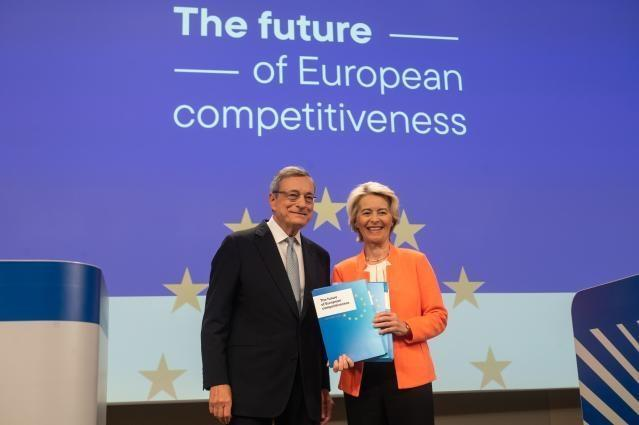
The contrast is unmissable between a) a democratic parliament and appointed commissioners that lionise regulation (sometimes good!):
and b) the Draghi report’s critique:
“the EU’s regulatory stance towards tech companies hampers innovation: the EU now has around 100 tech-focused laws and over 270 regulators active in digital networks across all Member States. Many EU laws take a precautionary approach, dictating specific business practices ex ante to avert potential risks ex post. For example, the AI Act imposes additional regulatory requirements on general purpose AI models that exceed a pre-defined threshold of computational power – a threshold which some state-of-the-art models already exceed.” [0] [1] [2]
EDIT: Just prior to publishing, Thierry Breton resigned from his position as commissioner. In his support, his views and actions are more reflective of public opinion than my own and many of his critics. At some distance, it is difficult to argue his approach was undemocratic. The AI bill was passed by a parliament of MEPs. He was appointed by an elected French government. While a given commissioner cannot be fired – as I understand – a two thirds vote of MEPs can dislodge all commissioners at once. Fairly or unfairly, he was held accountable.
What is the problem?
A country need not fund its operations with debt, nor need a region print its own fiat currency. Yet, should a country or region decide to do either of those things, the strength of its currency and ability to continue borrowing depend on being able to repay its debt eventually (and manage inflation in the interim).
A country’s ability to repay debt depends on its ability to impose taxes, and the ability to tax depends on the size of the economy, roughly measured by GDP (gross domestic product).
The ratio of what a country owes (debt) to what it produces (GDP) is what ultimately makes it’s debt and fiat currency sustainable or unsustainable – although there is no magic number setting a threshold between the two.
Countries or regions in a position of high debt to GDP are faced with three choices:
- To spend less (austerity), which is politically unpopular, and risks reducing not just debt, but also GDP, and
- To tax more, also politically difficult, and potentially risks hurting growth.
- To grow the economy, either by adding more people/labour OR by being more productive (technology).
If the EU and member countries wish to continue spending borrowed money and continue with a strong currency – absent making austerity or taxes work – the options are to increase labour or improve technology. The problem is, the EU is not on a strong path for either.
The People Problem
With a population that is growing there are plenty of tax-paying workers to pay the pensioners. Now, in Europe – and in China, population growth is starting to reverse.
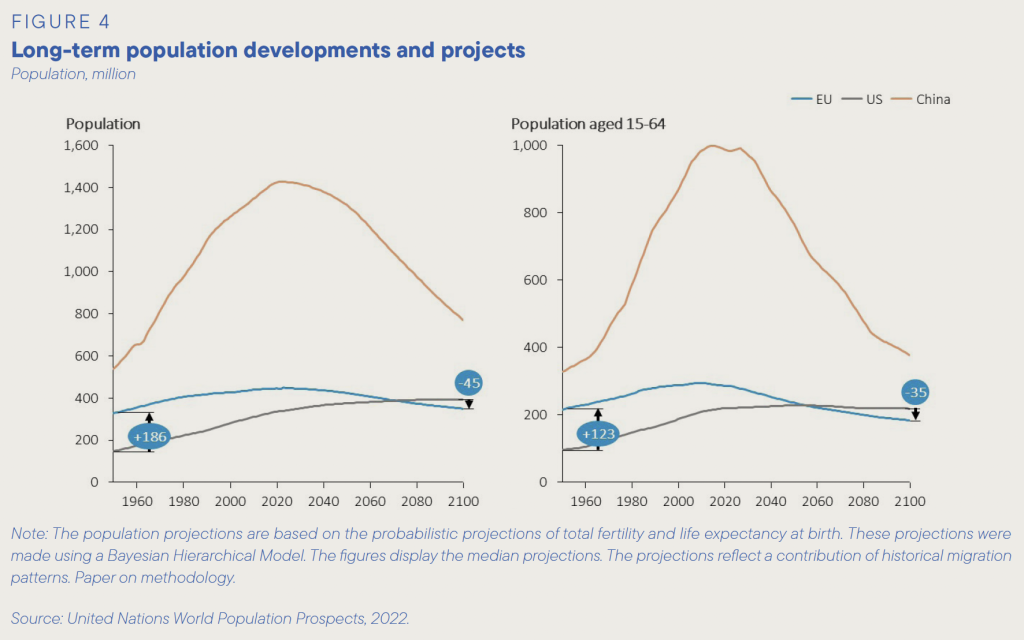
This chart surprised me in a few ways
- The EU looks in bad shape.
- China looks in really bad shape.
- The US looks reasonably ok. Immigration is helping to maintain population growth.
The specific problem here for Europe and China is that – considering labour alone – we are going to run out of young people to support the old people. The only hope is for technology to improve by so much that it more than makes up for the falling contributions of workers [3] [4].
“In 2022, the level of pension assets in the EU was only 32% of GDP while in the US total assets amounted to 142% of GDP and in the UK to 100%. This difference reflects the fact that most European households’ pension wealth takes the form of claims on public pay-as-you-go social security systems. EU pension assets are highly concentrated in a handful of Member States with more developed private pension systems. The combined share of the Netherlands, Denmark and Sweden in EU pension assets amounts to 62% of the EU total.“
The Technology Problem
Over the past two decades, the US and China have accelerated away from Europe in terms of GDP growth. Many of the macroeconomic critiques of the UK apply equally to the big countries in the EU.
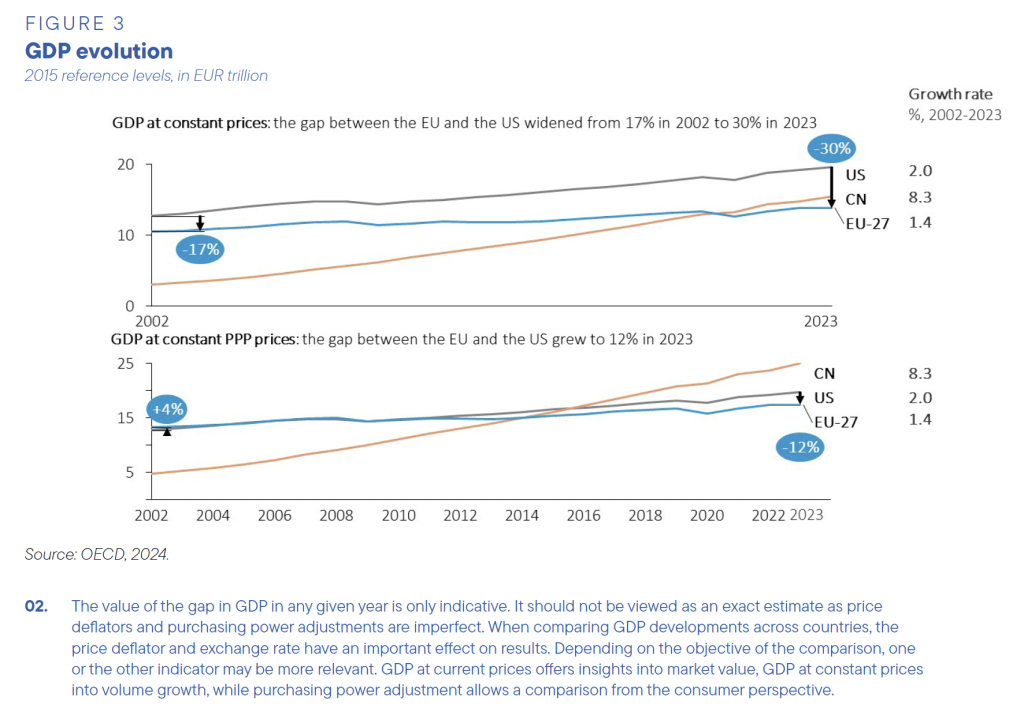
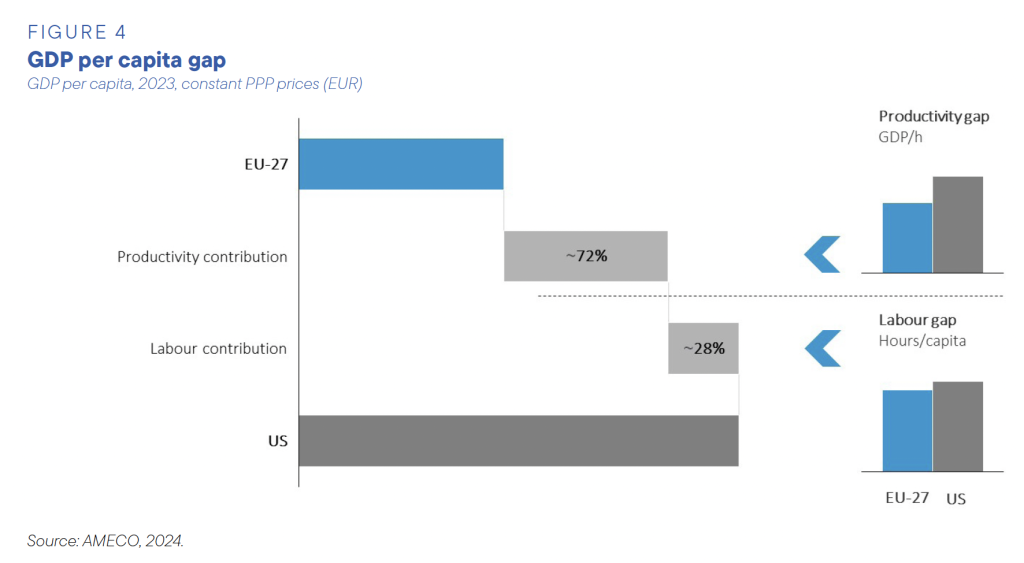
Most of the gap between US and EU growth is explained by differences in productivity (technology, practises). Yes, US workers work more hours per week, but they are much more productive per hour worked.
Software and computers have become a growing portion of all economies, and the US has had far greater growth in these industries than in Europe:
“Excluding the main ICT sectors (the manufacturing of computers and electronics and information and communication activities) from the analysis, EU productivity has been broadly at par with the US in the period 2000-2019. “
Three Problem Pillars
If growth won’t be achieved through population growth, that leaves the EU with reforming it’s approach to productivity and technology.
Draghi picks three strategic pillars for growth:
- Increasing technological growth and productivity
- Making energy cheaper while emitting less carbon dioxide
- Spending money on defence and security
I’ll go through each of them in turn.
Increasing technological growth and productivity
Draghi identifies the key problems as:
1. Excessive regulation (e.g. recent AI regulation, GDPR) – I’ve touched on this above already.
2. Excessive anti-trust regulation and insufficient consolidation.
The report goes contrary to many recent EU actions to block big companies buying other companies:
“There are 34 mobile network operator groups in the EU and only a handful in the US or China, in part because the EU and Member States have tended to view mergers in the sector negatively. This fragmentation makes the fixed costs of investing in networks relatively more onerous for EU operators than for continent-scale companies in the US or China. Fragmentation also makes it harder to capitalise on new technologies.”
In my view:
a) The productivity of large multi-nationals is known to be higher than small and medium sized business. That is not to discount the value of the cycles of death, renewal and growth that come from smaller business (and the fat-tailedness of their performance), but it points to larger companies driving productivity for an economy. Because large companies tend to be productive, it is a problem for productivity that we do not have large companies. It’s also a problem, perhaps, that Europe does not have more consolidated banking. This would at least allow banks to have more diversified portfolios of government bonds, rather than each set of national banks holding a lot of their own country’s national debt. As I understand, there are a range of EU countries whose government default would also take down their banks. [6]
b) If big companies cannot buy startups (even to quash competition) it kills a major source of financial return for early stage investors. This strikes me as a much bigger downside for startup investors than the upside of government driven accelerators and launch programs.
c) While there is huge consumer benefit (in terms of free/cheap goods and services) to having large companies, these large companies will gain power that makes them competitive with democratic governments. These are trade-offs to consider in the context of needing sustain a country/region’s borrowing and currency.
3. Fragmented markets, i.e. different rules in different countries
The word “fragment” appears 31 times in the 69 pages of the report. Clearly, in language, culture, capital markets, law, industrial and foreign policy, the EU is made of many parts.
Yes, this means the EU is much less of a homogenous market than the US, making it much less conducive to companies that scale (whose success partly provides the incentive for companies just starting out):
“there is no EU company with a market capitalisation over EUR 100 billion that has been set up from scratch in the last fifty years, while in the US all six companies with a valuation above EUR 1 trillion have been created over this period”
While I welcome consolidation in certain areas, like capital markets, I wonder:
- Is there political desire for further integration in EU countries?
- How much consolidation would be required to get to a level of consolidation like the US? Would that be worth it? What would be too much?
- Is the right industrial policy for Ireland the same as for Germany? Does further integration on industrial policy strengthen or weaken each country’s individual position?
- Could it be that, by integrating industrial policy, countries become complacent or disempowered to actively pursue trade and relationships outside the EU block (UK, US, Asia, Africa etc.)?
Interestingly, R&D spending appears similar in the US and EU:
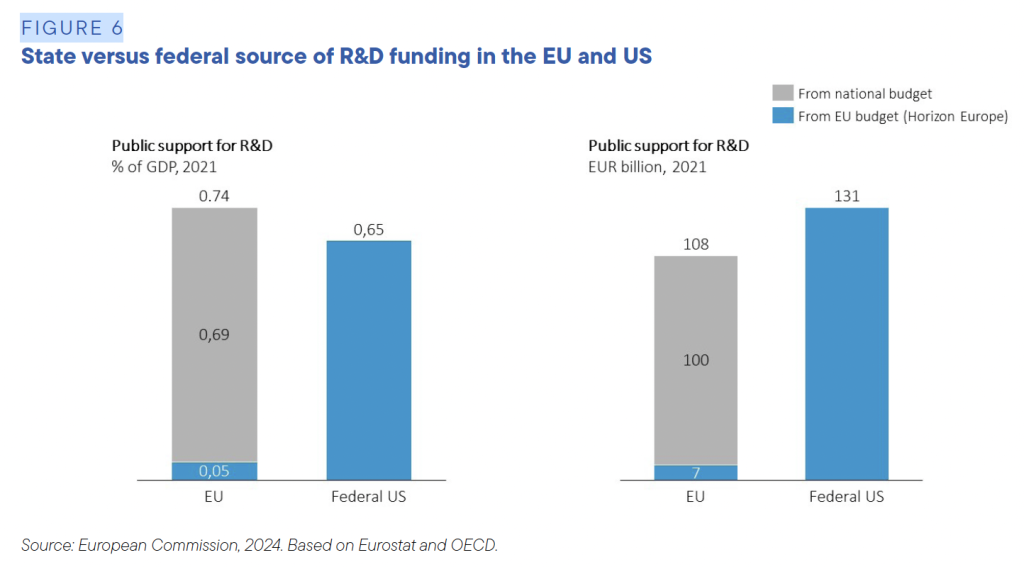
Yes, the EU does not have near-commercial programs at the scale of ARPA-E for Energy or DARPA for defence (and perhaps they are more effective on a per dollar basis than other governent R&D spending?), but raw R&D Euro do not seem to be a clear explainer of the productivity gap.
Making energy cheaper while emitting less carbon dioxide
- There is recognition that Europe’s energy policy poses a competitive disadvantage:
“Even though energy prices have fallen considerably from their peaks, EU companies still face electricity prices that are 2-3 times those in the US. Natural gas prices paid are 4-5 times higher.“
2. There is engagement with the difficult question of whether to impose trade barriers on China or not:
“Emulating the US approach of systematically shutting out Chinese technology would likely set back the energy transition and therefore impose higher costs on the EU economy. It would also be more costly for Europe to trigger reciprocal tariffs: more than a third of the EU’s manufacturing GDP is absorbed outside the EU, compared with only around a fifth for the US. However, a laissez-faire approach is also unlikely to succeed in Europe given the threat it could pose to employment, productivity and economic security“
3. There is clear-eyed language recognising that much of the energy problem is less a money problem and more a regulatory problem:
“…increasing the supply of finance for clean energy deployment will not yield the desired results without increasing the pace of permitting for installation.”
and
“A lengthy and uncertain permitting process for new power supply and grids is a major obstacle to faster installation of new capacity. Investments in both power generation and grids require several years between feasibility studies and project completion. However, there is a large variation in permitting times between Member States. The entire permit granting process for onshore wind farms can take up to 9 years in some Member States, compared with under 3 years in the most efficient ones. Ground-mounted solar PV systems can take 3-4 years to approve in some countries but 1 year in others. The time devoted to analyses of environmental impacts represents a significant share of the difference between best and worst performers.”
As is the case in parts of the US, environmental protection prevents environmental protection.
At the same time, I question certain claims made on the causes of high energy prices and volatility in prices:
“Europe’s market rules pass on this volatility to end users and may prevent the full benefits of decarbonising power generation from reaching them. Even as Europe reduces its dependence on natural gas and increases investment in clean energy generation, its market rules in the power sector do not fully decouple the price of renewable and nuclear energy from higher and more volatile fossil fuel prices, preventing end users from capturing the full benefits of clean energy in their bills [see Figure 5]. In 2022 at the peak of the energy crisis, natural gas was the price-setter 63% of the time, despite making up only 20% share of the EU’s electricity mix.”
I, perhaps wrongly, see these claims as mis-framed for a number of reasons:
- As I understand, gas is the price-setter because gas powered plants can flexibly turn on and off, whereas wind and solar power are available only when the wind blows or sun shines. At moments where the wind + solar power available drops below the grid’s demand, gas power will necessarily fill the gap and set the price. This is quite a large percentage of the time even though gas is often just “topping off” the base renewables load required.
- One could decouple energy prices from gas simply by banning gas. My estimation is that this would lead – at least in the short term – to higher prices of energy and hurt end users even more. In the medium term, falling battery and solar prices can help (not withstanding regulatory issues around installation) somewhat. As I understand, removing gas as the marginal price setter would require a very long term (3+ months) and cheap form of energy storage, particularly for countries further from the equator (video upcoming on this soon).
- Of the solutions suggested to address the coupling of electricity and gas price, one is the use of Contracts for Difference. These involve tendering out the supply of wind energy on a basis that is tied to the prevailing price of (typically) gas. While I support this as an approach (and it is already done to some degree), it does not prevent gas from setting market prices.
One last – more minor – critique on the topic of energy:
“The price differential vis-à-vis the US is primarily driven by Europe’s lack of natural resources, as well as by Europe’s limited collective bargaining power despite being the world’s largest buyer of natural gas.”
Perhaps the EU does not quite have the gas and oil resources of the US. At the same time, the EU has made decisions not to develop its own oil, gas and LNG infrastructure because of the warming effect on the planet of carbon dioxide emissions. As such, it seems a question not just of resources but choices around development.
Regarding bargaining power, Europe could exert more monopsony power on sellers of gas – to Europe’s advantage. This is something I had not considered. As to whether this is possible comes back to the game theory of independence/fragmentation (where the COVID and gas Nash equilibrium was largely for countries to go alone).
Spending money on defence and security
In one sense, the EU has benefited from low spending on military over the past half century:
“The safety of the US security umbrella freed up defence budgets to spend on other priorities.“
On the other hand, technologically, defensively and geopolitically (as the US withdraws from foreign involvement), this is at once a benefit and a drawback.
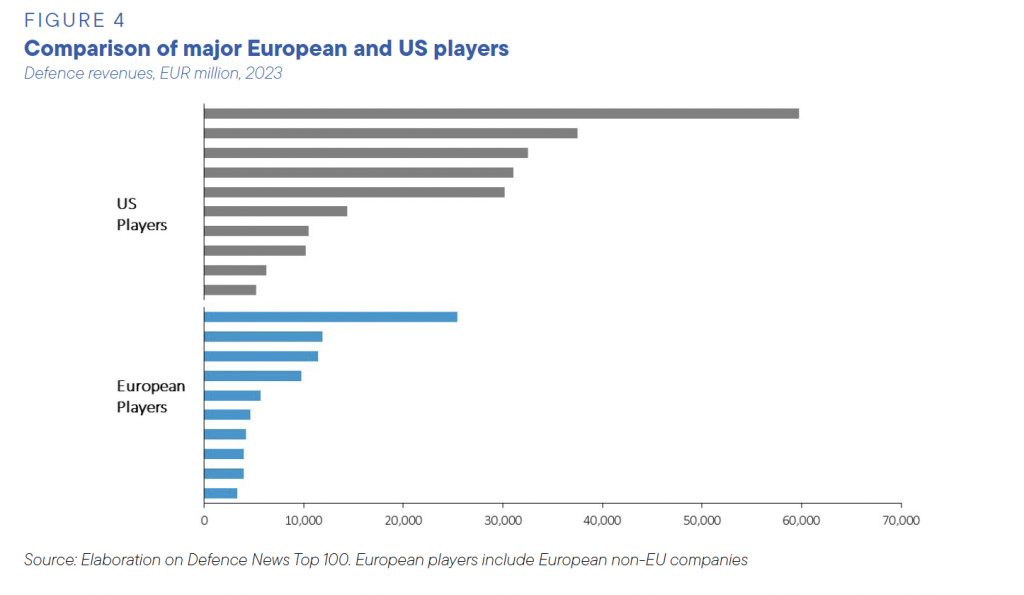
While spending and revenue is not necessarily a measure of effectiveness, European defence companies lag far behind US companies:
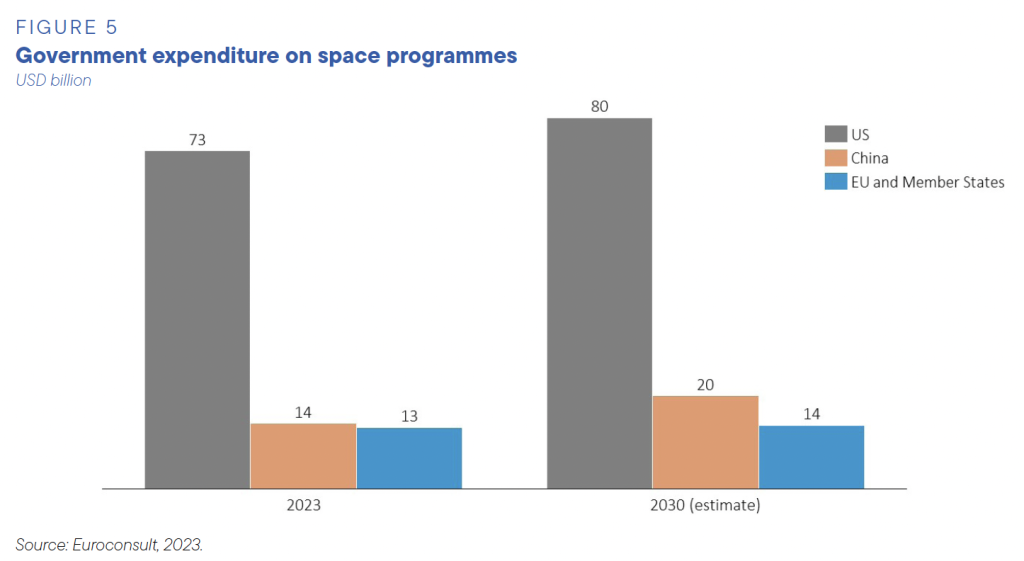
In space, Europe falls behind China and well beyond the US.
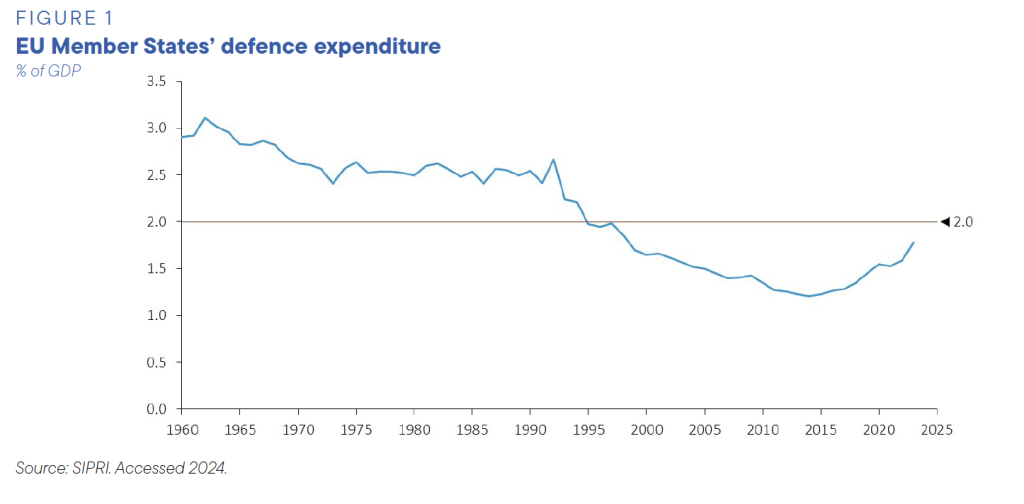
Again with the caveat that strength and deterrence are not measured solely by spending as a fraction of GDP, there is increased focus on defence by EU states, after a long period of decline:
When it comes to matters of unity and fragmentation, perhaps one should not forget that the EU emerged from collaborative relationships after the second world war.
Does Debt solve Debt?
And then there is the money question: How do these policy pillars of productivity/tech, energy and defence get paid for?
A central tenet of Mario Draghi’s report is the idea of centrally issued debt – a “safe asset” secured jointly by the governments of the EU:
“Finally, the EU should move towards regular issuance of common safe assets to enable joint investment projects among Member States and to help integrate capital markets”
For Isabel Weber (Massachusetts Amherst Economist interviewed on Lots More), one glaring difference causing the productivity gap between the US and the EU is simply that the US government spent far more – as a fraction of GDP – over the past few years.
On the other hand, Nassim Taleb (Trader, Philosopher) is likely glad Germany has constantly held Europe back on spending even more:
At my previous business in the US, I engaged a patent lawyer in the US who would bill at a rate over $1000 per hour. I’d tell him he’s charging far more than what is being charged elsewhere. He’d say “Well Ronan, it’s easy to measure the cost, but it’s not easy to measure the value.”
The question I pose – whether or not further debt could break the cameul’s back – is whether this is a money problem or a knowledge problem or a regulatory incentives/disincentives problem?
Given €10T, could one achieve a turnaround on productivity, energy and defence? Or, is this more like the inflation reduction act (IRA) in the US, where simplifying regulations could have done much more than the money?
Maybe it’s just Culture?
I was at a party over the weekend chatting with a friend who sells marketing software to businesses in the EU and in the US.
In Europe, customers would hesitate, ask for a free month, and maybe try it out after a few months.
In the US, customers would sign-up, pay for a month and try it right away. Maybe they would drop off after a month or two, but it would be much better – as an entrepreneur – to have that information on what customers did or didn’t want.
Measure what matters
While the first graph in the report is a pie chart of GDP by region, the second chart shows the share of income accruing to the richest 10%:
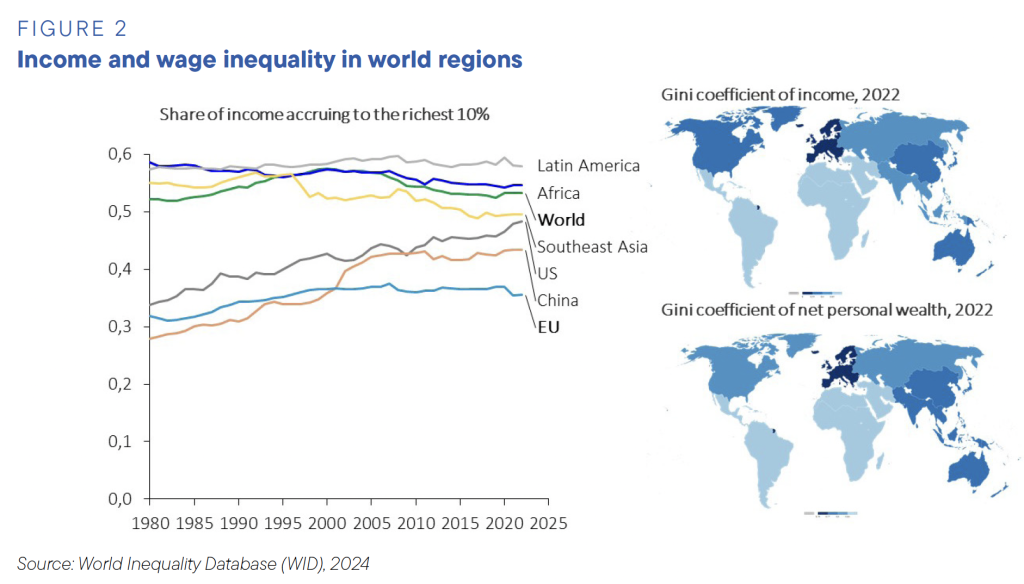
Here’s an alternative measure to focus on – not just a snapshot of who owns or earns what at a given moment in time – but a measure of income and wealth mobility over time. Randomness plays a significant role in the distribution of talent in the world. Properly harnessing that talent means optimising for mobility and having resources drawn towards talent – over time and space. At any one snapshot in time, it may be of benefit to have concentration in resources towards the prevailing talent provided a) there are resources allocated to maintain a social floor and b) when talent moves or new talent emerges, resources are drawn towards that talent and are not stuck.
We can talk about it
The Mario Draghi report is significant because the first step towards tackling a problem – slow EU economic growth – is being able to talk about it.
If we care about peace —both within Europe and in relation to the rest of the world— we might want to be proactive in maintaining our security.
And, if we in the EU care about sustaining – and improving – our living standards, we may wish to value economic growth as critically important.
We can work it out, The Beatles
“[Verse 3: Paul McCartney/Mario Draghi]
Try to see it my way
Only time will tell if I am right or I am wrong
While you see it your way
There’s a chance that we might fall apart before too long
[Refrain: Paul McCartney/Mario Draghi]
We can work it out
We can work it out”
~~~
Endnotes:
[0] Compared to more common law approaches of the US and UK, the EU’s approach to regulation might be described as preemptive and prescriptive. This can work if there is an understanding of what is being regulated. This may not work so well for regulating what is ill-defined in how it works and how it can be stopped, for example, “intelligence”.
[1] While raw compute is one dimension of intelligence, there are many others. For example, OpenAI’s recent o1 series of models relies on having models produce longer, more contemplative answers. It is not just a matter of raw compute, but how to spend that compute (on training versus inference).
[2] One alternative to being pre-emptive is to be responsive and focused on harms. The question of whether and how one should adopt pre-emptive versus responsive approaches to regulation is not straightforward. One might ask whether there are risks that are identifiable as serious, non-linear in impact, and, can pre-emptively be stopped. There is debate as to whether “AI” (however ill-defined that is) can lead to non-linear/extinction events. Even if one grants that risk, it remains difficult to see how one might preemptively shut down or curtail intelligence – at least without compromising other freedoms.
[3] in real terms.
[4] We could alternatively lower standards of living, but people don’t like that.
[5] Population prediction charts are sensitive to assumptions and not to be taken too literally.
[6] There are larger issues here with the Euro and EU banking, forthcoming in a book by John H. Cochrane, Luis Garicano and Klaus Masuch. My uncertain suggestion is for Europe to move closer to narrow banking (where banks are not permitted to lend more than reserves, shifting the balance towards private investment) – in line with this quote from Mario Draghi’s report:
“the EU relies excessively on bank financing, which is less well-suited to fund innovative projects and faces several constraints. Although the GFC and the ensuing bank deleveraging led to a greater role for capital markets and non-bank finance in Europe, bank loans are still the most important source of external finance for companies. However, banks are typically ill-equipped to finance innovative companies: they lack the expertise to screen and monitor them and have difficulties valuing their (largely intangible) collateral, especially compared to angel financiers, venture capitalists and private equity providers. Banks in Europe also suffer from lower profitability than their US counterparts – in large part because US banks gain higher net fee and commission income from operating in their deeper capital markets – and lack scale relative to their US counterparts owing to the incomplete Banking Union.“